To store and access personal browsing data for analyzing site traffic and for marketing. Read more and manage your consent at any time in our Privacy & Cookies Policy.
Statistics & analysis Helps us to improve our site and offering. Data is shared with Google. Expires within two years.
Marketing To be able to show ads from us when you visit other sites. Data is shared with third parties like Google, Facebook, LinkedIn. Expires never.
How Sushi Yama hit 95% digital orders and 20% higher AOV
By making owned digital channels the foundation of the guest journey, Sushi Yama built a more connected, higher-value business across app, kiosk, loyalty and delivery.
Stockholm, Sweden
May 11, 2026
(updated
May 11, 2026
)
Digital-first strategy became the foundation of the business
QSR digitisation is not new. Kiosks, branded apps, order-ahead, aggregator integrations and loyalty programmes have been table stakes for global operators for years. What separates brands today is no longer whether they have gone digital, but how far they have pushed the model and how disciplined they have been about channel economics along the way.
Sushi Yama's digital strategy was never about simply adding more ordering channels. The ambition was bigger than that: to build a digital-first business where owned channels are at the centre of the guest relationship, and where every touchpoint contributes to a more consistent, more valuable guest journey.
That shift has paid off. Today, around 95% of Sushi Yama's total orders come through digital channels across app, kiosk and delivery. Over the past three years, that share has continued to grow at roughly 6% annually, driven by continued investment in owned channels and a guest journey engineered for higher conversion, stronger upsell, and consistent loyalty recognition across all channels.
The 95% digital share is the headline number. The rest of this success story is about the commercial model behind it, from channel economics to first-party delivery to loyalty-driven frequency.
"For us, digital is not a separate sales channel, it is a core part of the guest experience and the business model behind it. By connecting ordering, loyalty and delivery, we have been able to strengthen the relationship with our guests, increase frequency and build a more scalable, commercially sustainable business."
Marcus Von Tell, Head of Digital Operations, Sushi Yama
About Sushi Yama
Sushi Yama is Sweden's largest sushi QSR chain, founded in 2008 and now operating over 60 locations nationwide, with a recently established local presence in Germany. The brand has built its reputation on fresh, high-quality ingredients and a modern take on Japanese cuisine, serving both dine-in and takeaway guests across its home market. Sustainability, digital innovation, and guest experience sit at the centre of how the business is run. Today, Sushi Yama is widely regarded as the category benchmark, and is actively scaling the same model internationally.
The numbers behind the model
95% of total orders now come through digital channels
6% annual growth in digital order share over the last three years
20% higher AOV for digital orders compared with POS
25% of total order volume now comes from delivery
10% of delivery orders currently come through Sushi Yama's own channel
10% higher AOV in the brand's own delivery channel compared with marketplaces
1.5x higher visit frequency among loyalty members compared with non-members
From fragmented systems to one connected guest journey
Ask Sushi Yama what held them back, and the answer is refreshingly blunt. Fragmented systems and dependence on third-party platforms had historically limited both control and profitability. Delivering a consistent guest experience across channels, and eventually across markets, proved genuinely difficult when ordering, loyalty, and delivery sat in separate silos owned by separate vendors.
The response was architectural, not cosmetic. The team rebuilt the stack around a single integrated platform that runs ordering, loyalty, and delivery together. That shift did three things at once. It raised conversion. It stabilised operations. And it gave the commercial team a single source of truth on guest behaviour, which made experimentation dramatically cheaper and faster to run.
Digital orders now generate 20% higher AOV
As Sushi Yama increased its digital share, it also improved the value of each transaction.
Digital orders now deliver 20% higher AOV than orders placed through POS. That premium is not a happy accident. It is the result of treating every digital touchpoint as a commercial surface to be designed and optimised, rather than simply a faster way to place the same order.
Three reinforcing mechanisms drive the uplift. Menu architecture built for how guests actually browse on a screen rather than a direct reproduction of the counter menu, with high-margin items, bundles, and add-ons surfaced at the moments guests are most receptive to them. Structured upsell and cross-sell built into the checkout flow, engineered around the brand's own menu mix and margin profile, and deployed consistently on every single order. And a guided purchase journey that makes it easy for guests to build a fuller basket through sides, drinks, upgrades, and complementary items offered at the natural decision moments in the flow.
The app became the value driver, while kiosk became the volume engine
Sushi Yama's omnichannel model works because each channel has a clear role.
The brand's own app drives the highest value per guest and the strongest loyalty. It is where personalisation lands hardest, where repeat behaviour is most visible, and where guest recognition pays off commercially. For that reason, the business actively prioritises its own app. It is the channel where Sushi Yama can deliver the strongest experience, protect profitability and retain the deepest insight into guest behaviour.
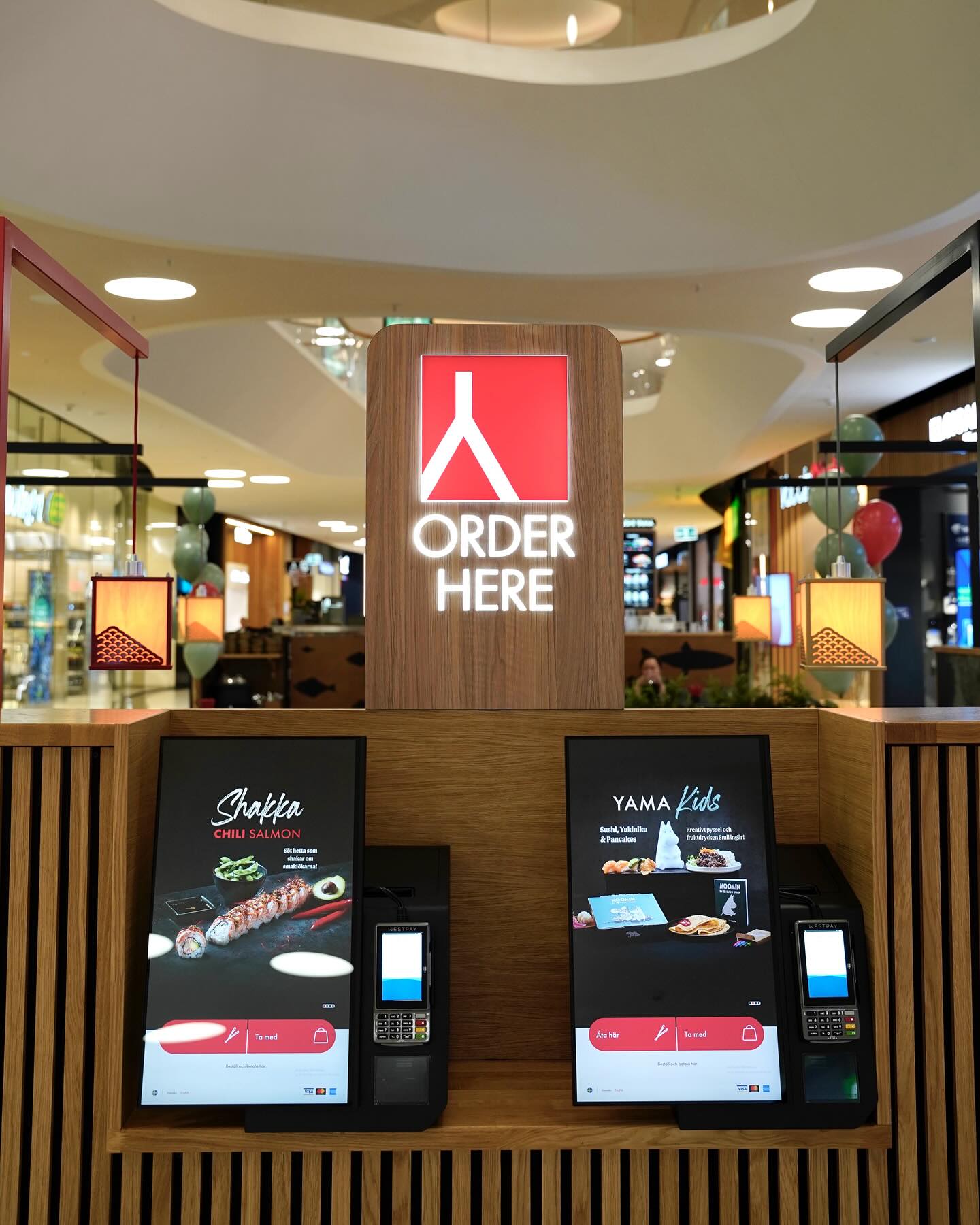
Kiosk, on the other hand, plays a different role. It supports high-volume ordering and performs especially well in busy locations where speed of service and throughput matter. In a category where peak capacity sets the ceiling on weekly revenue, the kiosk is one of the highest-ROI assets in the building.
That clarity is part of what makes the strategy effective. Sushi Yama is not trying to make every channel do the same job. Each channel has a job. Each channel is measured on that job. The brand experience stays consistent across the full guest journey, while each touchpoint is tuned to what it does best.
White label delivery generates 10% higher AOV than marketplaces
Delivery today accounts for around 25% of Sushi Yama's total order volume, making it a significant part of the business.
At the moment, roughly 10% of delivery orders come through the brand's own channel. While that shows there is still meaningful room to grow direct delivery, the economics are already moving in the right direction: AOV in Sushi Yama's own delivery channel is approximately 10% higher than on marketplaces.
That premium is structural rather than promotional, and three reinforcing QSR-specific factors drive it.
First, consistent pricing across all channels, which removes the margin compression that marketplace fee structures often force onto the menu. Second, full ownership of the upsell and cross-sell flow at checkout, engineered around Sushi Yama's own menu mix and margin profile rather than inside someone else's flow. Third, the ability to reward loyalty members on delivery orders the same way they are rewarded in the app or at the kiosk. Members ordering delivery through the brand's own channel are recognised, earning points, and seeing relevant upsells. Through a marketplace, those same members are commercially anonymous.
The result is a strategically important one. Owned delivery is not only about avoiding third-party dependency. It is about creating better-value transactions. In its own channel, the brand builds a direct relationship. In marketplaces, it primarily buys reach. Over time, that difference matters.
Loyalty drives 1.5x higher visit frequency
In Sushi Yama's model, loyalty is designed to drive frequency rather than to lift basket size, and the data confirms the strategy is working. Members have a slightly lower AOV per order than non-members, largely because loyal guests often receive discounts and rewards. They also visit around 1.5 times more often.
The trade works heavily in the brand's favour. A slightly smaller ticket captured repeatedly, from a guest the business can identify, understand, and influence, generates substantially more long-term value than a larger ticket captured once from an anonymous walk-in. More frequent visits strengthen lifetime value, deepen brand affinity, and make demand more predictable over time.
This is why loyalty, measured correctly, is one of the strongest growth engines in QSR. The metrics that matter are frequency, identified share of visits, and cohort retention, not basket size at the point of transaction. By linking loyalty directly to its owned digital channels, Sushi Yama has turned frequency into a measurable and scalable commercial lever.
Owning guest data turned digital into a strategic advantage
Sushi Yama's commercial edge comes from being able to see, recognise, and understand its guests across every channel at once.
Every order placed through an owned channel is identified, attributed, and logged against a known guest. That data then shapes menu design, personalisation, loyalty mechanics, commercial experimentation, and the operational decisions made at unit level. Over time, those feedback loops compound into sharper offer targeting, stronger upsell, higher conversion, and more accurate demand forecasting.
In marketplace environments, those feedback loops do not exist. The guest is abstracted behind the aggregator. The brand sees the order but not the person. As Sushi Yama puts it, in the brand's own channel it builds a relationship, and in marketplaces it rents volume. The first produces compounding insight. The second produces transactions.
One omnichannel model, ready for international rollout
The same operating model Sushi Yama has refined across its Swedish footprint is now being deployed in Germany, with no architectural rebuild required to do it.
That matters commercially because international expansion in QSR is usually limited by exactly the thing Sushi Yama removed early: digital fragmentation across markets. Every new country that requires a new POS stack, a new loyalty instance, or a new delivery integration adds operational complexity, slows rollout, and diverges the guest experience from market to market. Sushi Yama has engineered that cost out of its expansion plan.
The German strategy is a direct replication of what is already working at home. Owned channels as the foundation. Marketplaces used selectively for reach. Digital share pushed high from the start, so direct guest relationships are being built from day one rather than reclaimed years later. The platform is the same. The commercial playbook is the same. Only the market is new.
Digital is an operating model, not a channel strategy
The central lesson of Sushi Yama's story is one most QSR brands are still working toward. Digital is not a set of channels to be bolted onto the business. It is the business.
Every significant result in this success story ties back to that single reframing. A 95% digital order share, 20% higher AOV than POS, 10% higher AOV in owned delivery than marketplaces, and 1.5x higher visit frequency among loyalty members are not four unrelated wins. They are four visible outputs of the same underlying operating model, one built around owned channels, integrated loyalty, and first-party data as the strategic backbone of the business.
For operators designing their next phase of digital growth, Sushi Yama's practical advice is worth taking seriously: build your own channel early, make it meaningfully better than the alternatives, and treat marketplaces as a complement rather than a strategy. Sushi Yama's numbers show what that hierarchy looks like when it is applied with discipline over time.



.png)


